
WHAT IS CRAFT BEER WHEN YOU REMOVE THE ALCOHOL?
By Jimmy C.
It is a question that sounds simple until you sit with it for a moment. What is craft beer, exactly? And what happens to that definition when you remove the alcohol?
Most people have an instinctive feel for what craft beer means, even if they could not write it down precisely. Small brewery. Interesting ingredients. A brewer who cares about what goes into the glass. Beer that tastes like someone made a decision about it rather than a machine optimising for volume and shelf life. That feeling is real, but it is also worth being more precise about, because the answer changes how you think about non-alcoholic craft beer and whether the category is genuine or just clever marketing.
Spoiler: it is genuine. But the reasoning behind that matters.
WHAT CRAFT BEER ACTUALLY MEANS
The most widely referenced formal definition comes from the Brewers Association in the United States, which defines an American craft brewer as small and independent. Small means producing fewer than six million barrels of beer annually, which is roughly 3% of total US beer sales. Independent means less than 25% of the brewery is owned or controlled by a beverage alcohol industry member that is not itself a craft brewer.
The Brewers Association notably removed the word traditional from its definition in 2018, having previously required craft brewers to derive the majority of their flavour from traditional or innovative brewing ingredients and their fermentation. The removal was deliberate: as the industry evolved, the old definition excluded too many breweries that were doing genuinely interesting, quality-driven work. What remained was the focus on scale and independence.
But if you ask most craft beer drinkers what they actually mean by the term, scale and independence are proxies for something more qualitative. They mean deliberate decision-making about ingredients. Flavour led by intention rather than cost. A brewer who starts with what they want the beer to taste like and works backwards, rather than starting with a price point and engineering something that clears it. The Brewers Association definition captures the conditions that tend to produce that kind of brewery. It does not capture the quality itself.
The hallmark of craft beer and craft brewers, as the Brewers Association's own literature states, is innovation. That is the closer definition. Not small. Not traditional. Innovation.
WHERE ALCOHOL FITS INTO THE DEFINITION
Here is the thing that often goes unexamined: alcohol is not part of any serious definition of craft beer.
The Brewers Association definition says nothing about ABV. The Oxford Dictionary definition of craft beer, a beer made in a traditional way by a small company, says nothing about ABV. The qualities most people associate with craft beer, interesting ingredients, flavour complexity, brewing process transparency, independence from industrial mass production, have no inherent relationship to alcohol content.
Alcohol is a byproduct of fermentation, not a marker of craft intent. A brewery can produce a full-strength IPA with complete indifference to quality, using industrial shortcuts and commodity ingredients, and it is not craft by any meaningful standard even if it contains 6% ABV. Conversely, a brewery can apply every ounce of its technical knowledge and brewing philosophy to producing something under 0.5% ABV, and that product is craft in every sense that matters.
The confusion arises because, historically, removing alcohol from beer involved processes that actively worked against craft quality. Heat evaporation and reverse osmosis strip out the volatile aromatic compounds that make a well-brewed beer interesting. The product that came out the other side was thin, flat, and forgettable, which led people to associate NA beer with a lack of craft rather than with a different brewing challenge. The issue was never the absence of alcohol. It was the method used to achieve that absence.
WHAT CHANGED: THE CRAFT NA BREAKTHROUGH
The shift that has made genuine craft NA beer possible is a brewing philosophy change rather than a technology change, though technology played a supporting role.
The old question was: how do we make a normal beer and then remove the alcohol carefully enough to preserve some of what made it good? The craft NA question is different: how do we brew beer that never builds up significant alcohol in the first place, while preserving everything that makes craft beer interesting?
That second question is harder to answer. It requires controlling fermentation from the start rather than correcting it after the fact. It requires understanding how yeast behaviour, temperature, grain selection, and hop scheduling interact differently at very low alcohol levels. It requires the same obsessive attention to process that defines craft brewing at any ABV, applied to a brewing challenge that most industrial producers were not interested in solving because the economics did not justify it.
The breweries that solved it were, without exception, craft breweries. Not large industrial operations with better machinery. Craft breweries that approached the problem the way they approach every brewing challenge: start with what you want the beer to taste like, then figure out how to get there.
By 2025, volume sales of NA beer in the US had risen 111% from 2021, while dollar sales rose 159% over the same period. The Brewers Association, tracking the category for the first time as a meaningful segment, noted that craft producers were driving much of that momentum. Non-alcoholic beer grew 30% year over year in scan data in 2024 alone. The category that was once an industrial afterthought has become one of the most technically demanding and fastest-growing areas in craft brewing.
the three questions that define craft na beer
When someone asks whether a non-alcoholic beer is genuinely craft, there are three questions worth asking. They apply to any craft beer claim, but they are especially revealing in the NA context because the NA category still has a significant quality gap between the genuine article and the products that are simply labelled craft without earning it.
First: how was the alcohol limited? Arrested fermentation, which controls the brewing process from the start to prevent significant alcohol from developing, is a craft approach. It requires deliberate process design and precise technical control. Reverse osmosis and heat evaporation, applied to a full-strength base beer to strip alcohol out after the fact, are industrial processes that tend to damage the flavour compounds that make a beer interesting. The method is not just a production detail. It is the single strongest indicator of whether the brewer started with flavour or started with a regulatory threshold.
Second: what are the actual ingredients, and are they there for flavour reasons? Craft beer uses quality malt, interesting hop varieties chosen for their specific aroma profiles, and controlled fermentation. The ingredient decisions are traceable to flavour outcomes. If a brewery cannot tell you specifically why they chose a particular hop variety or grain bill, that is worth knowing.
Third: does it taste like something worth choosing on its own merits? This is the simplest and most honest test. Craft beer is chosen because it is good. Not because it is responsible, or low calorie, or the only non-alcoholic option at an event. Because it is actually worth drinking. If a non-alcoholic beer requires a health justification to explain why someone would choose it, it has not yet cleared the craft bar regardless of what the label says.
what this means for tiny
Garage Project is a craft brewery by every definition that matters. Founded in Wellington in 2011 in a former petrol station in Aro Valley, they have won Champion Large Brewery at the NZ Brewers Guild Awards three consecutive years running and took Champion Large International Brewery at the Australian International Beer Awards in 2023, the world's largest beer competition. Their approach to brewing is characterised by technical obsession, deliberate ingredient choices, and a willingness to take on genuinely difficult challenges.
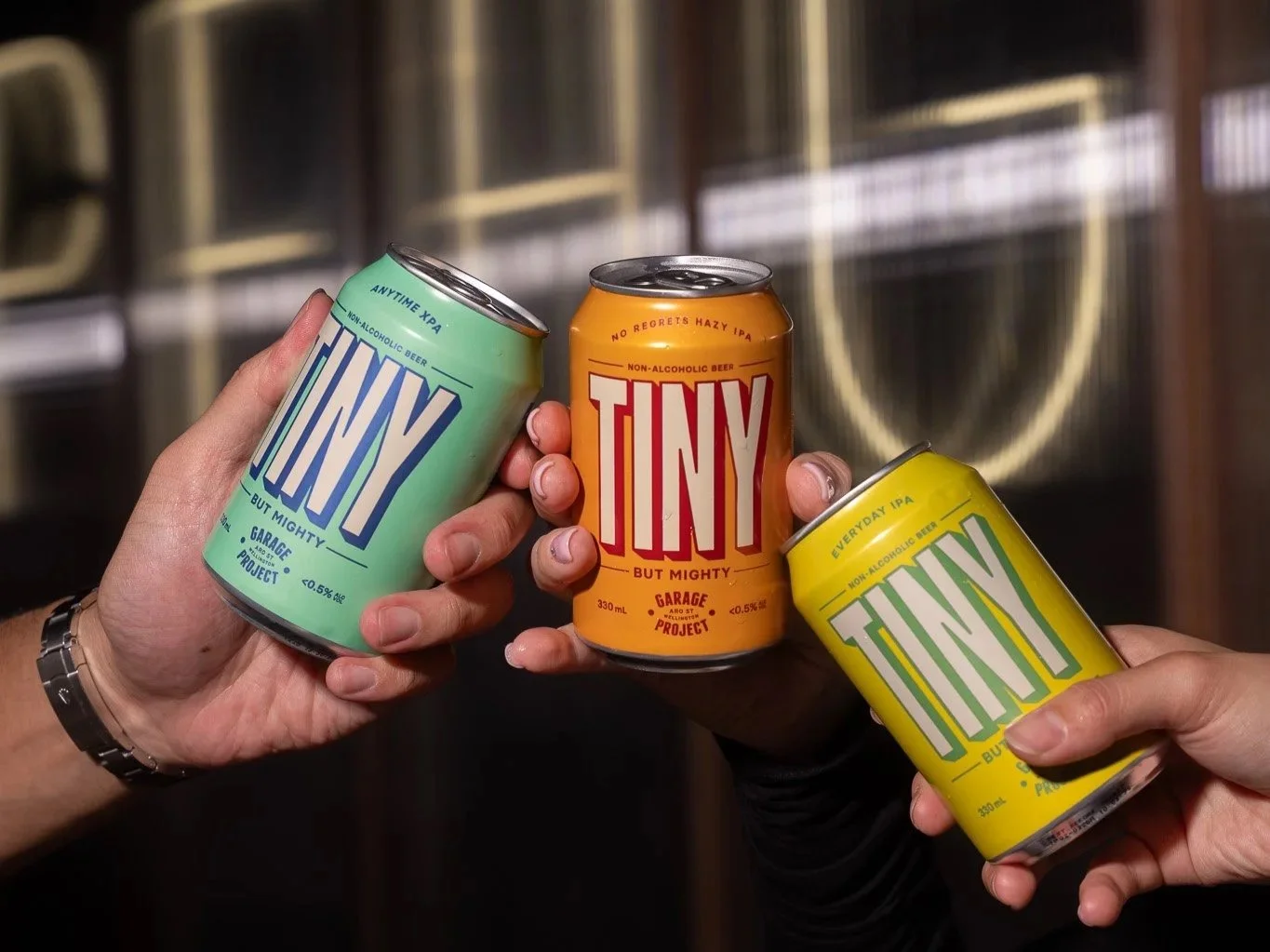
The TINY range is the result of applying that craft philosophy to one of those difficult challenges. Rather than producing a full-strength beer and dealcoholising it, Garage Project uses specialised, often proprietary fermentation techniques, including methods akin to arrested fermentation, to limit alcohol production from the start. The Hazy IPA gets its tropical aroma from Mosaic, Strata, and Simcoe hops chosen specifically for their aromatic profiles. The XPA gets its bright citrus character from Simcoe, Strata, and Citra. The Lager with Lime is brewed with malt and maize, as a Mexican-style lager should be. The Day and Night Stout gets its coffee and dark chocolate notes from roasted malts, not flavourings.
Every ingredient decision is traceable to a flavour outcome. Every brewing choice reflects a question about what the beer should taste like rather than what threshold it needs to clear. That is the craft beer meaning applied without qualification to a sub-0.5% ABV product.
At 59 calories for the IPA, XPA, and Lager with Lime, 72 for the Stout, and 79 for the Hazy IPA, it is also craft beer that fits more moments of your day than most full-strength options. Not as a compromise. As a deliberate product of a brewery that knows exactly what it is doing.
the honest answer
So what is craft beer when you remove the alcohol? It is the same thing craft beer always was. Beer where the decisions were made in service of what ends up in the glass, by a brewery that cared enough to do the hard work of getting it right.
The alcohol was never what made beer craft. It was just, for a long time, the only context in which the craft question was being asked seriously. That has changed. The breweries that took the NA challenge seriously are producing things genuinely worth drinking. And the drinkers who try them on their merits, rather than because of what they avoid, are the ones who are going to be ahead of a conversation that is only getting louder.
If you are new to craft NA beer and wondering where to start, start with a brewery you already trust. That has always been the best way into any new corner of craft beer.
Drink TINY, live mighty.