
ALCOHOL CONSUMPTION TRENDS: UNDERSTANDING THE SHIFT AWAY FROM BEER
By Jimmy C.
Something interesting is happening to beer: people are drinking less of it.
At least, that's what the headlines suggest. Younger consumers are moderating their alcohol intake. Traditional beer volumes are under pressure in several established markets. Sober-curious drinking has moved from a January challenge into something people practise throughout the year.
It would be easy to read those alcohol consumption trends and conclude that people are simply losing interest in beer. But look a little closer and the story becomes more complicated. People still want the cold can after work. The beer with a burger. The round with friends. The drink in hand at a barbecue, restaurant, concert or sporting event.
What increasingly seems to be changing isn't necessarily people's relationship with beer: it's their relationship with alcohol.
PEOPLE AREN’T JUST DRINKING LESS - THEY’RE DRINKING DIFFERENTLY
For decades, drinking culture was relatively straightforward: you drank, or you didn't.
Moderation existed, of course, but the alternatives rarely made it particularly appealing. Ordering a soft drink while everyone else had a beer felt different because it was different — different taste, different ritual, different experience.
Today's drinking culture is considerably more fluid. Consumers might drink alcohol on Friday, skip it on Saturday afternoon, have a non-alcoholic beer during the week and return to a full-strength beer at dinner the following weekend.
That behaviour is sometimes described as zebra striping: alternating alcoholic and non-alcoholic drinks rather than committing entirely to one category.
And it tells us something important about current alcohol consumption trends. Moderation doesn't necessarily mean abstinence. Increasingly, it means choice.
WHY ARE ALCOHOL CONSUMPTION TRENDS CHANGING?
There's no single explanation. Health awareness is certainly part of it. Consumers have greater access to information about sleep, recovery, calories, fitness and the effects alcohol can have on the body. But practicality matters too.
Modern social lives don't always fit neatly into "drinking nights" and "non-drinking nights."
Dinner might happen before an early gym session. A networking event might fall the night before an important presentation. Saturday drinks might sit between a morning run and Sunday plans. The consequence is a growing awareness of what comes after the drink.
People still want to participate in the occasion. They just don't necessarily want every occasion to come with the same alcohol load. That's a subtle distinction, but it's reshaping the drinks industry.
YOUNGER DRINKERS ARE CHANGING THE RULES
Much of the conversation around declining alcohol consumption focuses on Gen Z, and with good reason. Younger consumers have demonstrated particularly strong interest in moderation, wellness and alcohol alternatives. But reducing alcohol consumption isn't confined to one generation. Millennials are moderating too. So are older consumers.
What's particularly interesting about younger drinkers isn't simply that some of them drink less. It's that many appear less attached to the old social rules around when you're supposed to drink.
Choosing a non-alcoholic beer doesn't necessarily mean identifying as a non-drinker. Having a full-strength beer doesn't mean you're drinking for the rest of the evening. The category boundaries are becoming less rigid. And once those boundaries loosen, beer has to compete on something other than alcohol.
It has to be worth drinking.
THAT'S WHY NON-ALCOHOLIC BEER MATTERS
If consumers were genuinely abandoning beer itself, you'd expect the entire category to shrink with them. Instead, non-alcoholic beer has become one of the most closely watched areas of the drinks market.
It suggests that at least part of the shift away from traditional beer isn't a rejection of hops, malt, bitterness, refreshment or the ritual of cracking open a cold can. It's a demand for those things in a different format.
And that's only become possible because the product has changed. Older NA beers often asked consumers to accept a trade-off: less alcohol, but also less flavour, body and character. Modern brewing techniques have made that proposition far more interesting.
Brands can now build beers around low alcohol from the beginning rather than treating alcohol removal as an afterthought. Which brings us to TINY Beer.
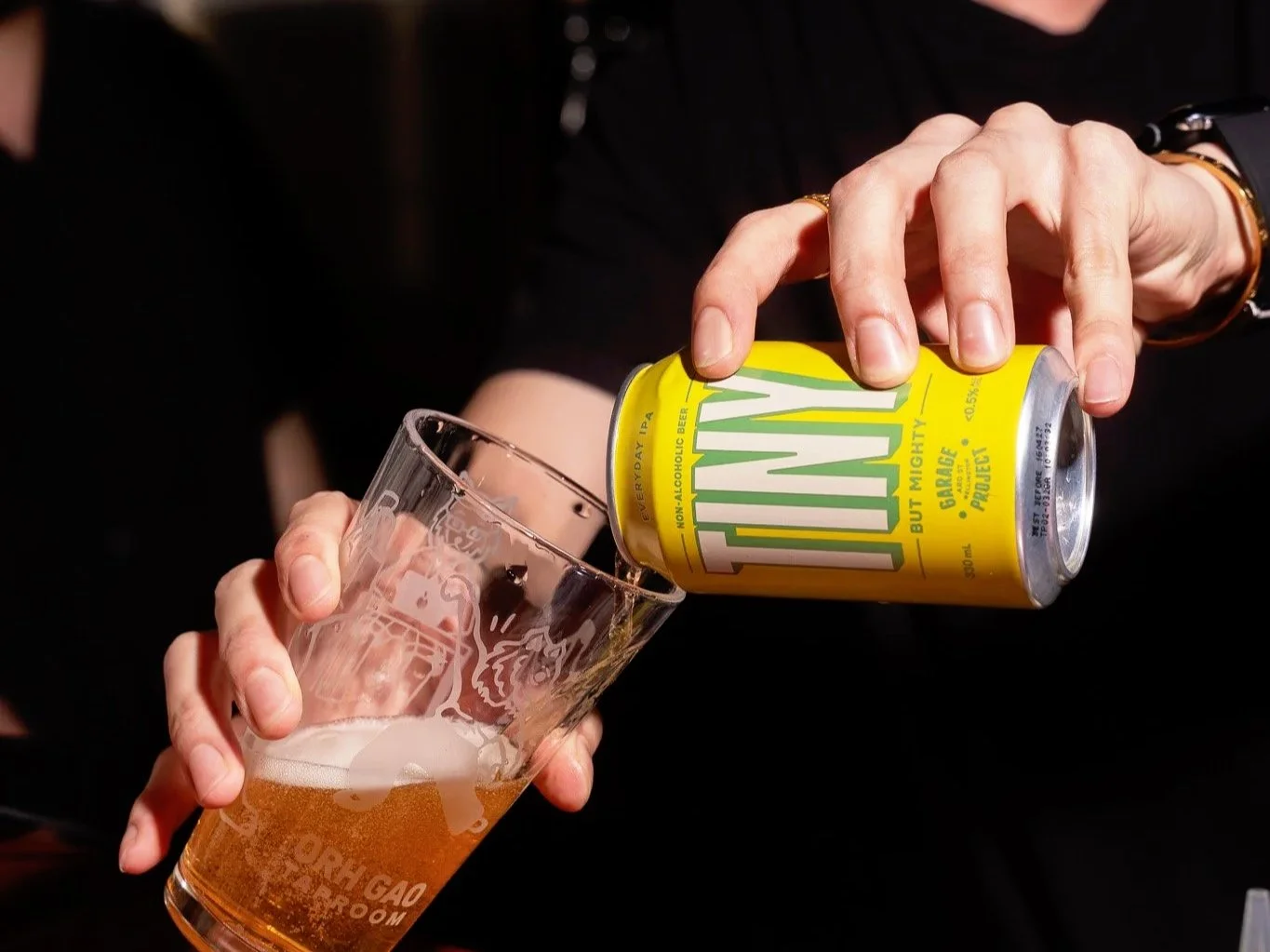
TINY isn't built around the idea that people should stop drinking beer. It's built around the idea that beer doesn't always need 4%, 5% or 6% ABV to have a place in someone's day. That's a very different proposition.
THE OCCASION HAS BECOME MORE IMPORTANT THAN THE CATEGORY
Imagine two people sitting at the same table. One orders a regular IPA. The other orders a TINY Hazy IPA at under 0.5% ABV.
Ten years ago, we might have interpreted those choices as statements about the people making them: one drinks, the other doesn't. Today, they could simply be making different decisions about Tuesday night. That's perhaps the most important shift.
Consumers increasingly have enough options to choose according to the occasion rather than according to a fixed drinking identity: lunch before heading back to work, a long dinner where you want to stay switched on, beer after a training session, an afternoon barbecue, a midweek catch-up, or night when you simply don't feel like drinking much alcohol.
Non-alcoholic beer creates additional beer occasions rather than simply competing for existing ones.
For a brand like TINY, that's the interesting space: not asking why aren't you drinking? but what do you want to drink right now?
BEER IS NOT DISAPPEARING, ITS ROLE IS CHANGING
This is where the phrase "shift away from beer" can be misleading.
Yes, traditional alcohol consumption patterns are changing. Yes, consumers are becoming more deliberate about how much they drink. And yes, the assumption that every social occasion automatically requires alcohol is weakening.
But none of that necessarily means the experience people associate with beer is disappearing. In some ways, the opposite is happening.
As non-alcoholic beer improves, beer becomes available to occasions where traditional beer didn't always make sense. That's a meaningful expansion of what the category can be.
TINY's Everyday IPA can sit alongside lunch. Anytime XPA can make sense when there's still a lot of days ahead. Lager with Lime works when Singapore delivers one of those afternoons where something cold is basically compulsory. And Hazy IPA can still deliver the hop character craft drinkers expect when the alcohol isn't what they're there for.
The future of beer may not be about convincing people to drink more. It may be about giving them more opportunities to choose beer.
THE REAL SHIFT IS FROM HABIT TO CHOICE
For a long time, alcohol and beer were treated as inseparable. Want the beer experience? Alcohol came with it.
The latest alcohol consumption trends are beginning to break that connection. Consumers now have more control over how much alcohol a particular occasion — whether that's 5%, under 0.5%, or none at all.
That's why the growth of non-alcoholic beer shouldn't necessarily be read as evidence that beer is losing relevance. It's evidence that beer is adapting. And perhaps that's where TINY fits best. Not as the beer you drink because you're not drinking. Just another beer you can choose because it's exactly what the moment calls for.
Drink TINY, celebrate mighty!