
New Drinking Pattern: Why Everyone's Talking About Zebra Striping
By Jimmy C
Every so often a name comes along that perfectly captures something people were already doing but had no word for: zebra striping is one of those names.
The concept is simple: you alternate between alcoholic and non-alcoholic drinks throughout a night out, creating a pattern across the evening. One with, one without. Back and forth. Like the stripes on a zebra.
It sounds almost too neat to be a real thing. And yet Google Trends data shows searches for zebra striping surged 975% in the US over the past year. Vogue covered it. Forbes covered it. The Times covered it. It showed up in bar industry trade publications and Euromonitor's World Market for Alcoholic Drinks 2025 report cited it as one of the defining behavioural shifts reshaping the drinks category globally.
The name is new. The behaviour, it turns out, is not.
What It Actually Looks Like in Practice
Here is the honest version of zebra striping: you probably already do some version of it without calling it anything.
You are three drinks into a work dinner and you switch to water for a round. You are at a long Sunday lunch and you alternate between wine and sparkling water because you have the afternoon to get through. You are at a networking event and you grab a beer first, then something non-alcoholic, then maybe another beer later.
None of that behaviour is new. What is new is that it has a name, and that name has made it feel intentional rather than apologetic. You are not slowing down because you have had enough. You are zebra striping. The framing matters.
According to research cited by The Conversation, 25% of UK pub goers already alternate between alcoholic and non-alcoholic drinks. More strikingly, among 18 to 24 year olds in the UK, that figure rises to 78%. Nearly four in five young adults are already doing some version of this, with or without the terminology.
Why It Works Better Than Most Moderation Strategies
Most approaches to drinking less require you to opt out of something. Dry January asks you to skip the month entirely. Not drinking at a work event requires you to explain yourself. Even ordering a soft drink at a bar can feel like dropping out of the social moment.
Zebra striping does not ask you to opt out. It asks you to stay in, but more deliberately.
The mechanism is straightforward. Alternating between alcoholic and non-alcoholic drinks effectively halves your alcohol intake across an evening while giving your body more time to process what you have consumed. The practical result is better hydration, a slower rate of intoxication, fewer calories across the night, and a meaningful reduction in how you feel the next morning.
What makes it socially sustainable is that you are never without a drink. You are not the person who switched to water and quietly dropped out of the rhythm of the evening. You are still at the table, still in the conversation, still holding something cold and worth drinking. You have just made a choice about what that drink is every other round.
That distinction is more important than it sounds. The barrier to moderation has rarely been willpower. It has been the social cost of making a visible choice to opt out. Zebra striping removes that barrier entirely.
The Numbers Behind the Shift
This is not just a behavioural quirk among a niche group. Euromonitor International's 2025 data paints a clear picture of the broader context.
Only 23% of respondents report drinking weekly in 2025, down from 25% in 2020. Among those who do consume alcohol at least occasionally, 53% say they are actively trying to cut back, up from 44% five years ago. The alcoholic drinks industry reached 253 billion litres in 2024, but volume growth has essentially flatlined at 0.6%.
Crucially though, and this is the part that makes zebra striping so commercially interesting, 94% of non-alcoholic beverage buyers surveyed by NIQ said they continued to purchase alcoholic beverages alongside NA alternatives. This is not an abstinence movement. It is a moderation movement. People are not choosing sides. They are choosing both, on their own terms, in the same evening.
IWSR projects the no-alcohol category in the US will grow at an 18% compound annual growth rate from 2024 to 2028, driven by new consumers and increased consumption frequency. And 61% of American non-alcoholic beer consumers in April 2024 were Millennials, up from 45% in 2018. The category is moving squarely into the mainstream.
The Product Has to Be Worth It
Here is the thing about zebra striping that does not get said enough: the strategy only works if the non-alcoholic drink in your hand is actually worth drinking. If you alternate between a craft IPA and a flat, thin NA beer that reminds you of something missing, you are not really zebra striping. You are tolerating every other round. That is a different thing entirely, and it does not hold up socially or personally for very long.
The reason zebra striping has taken off now, rather than ten years ago when the concept was equally logical, is that the NA options available today are genuinely worth choosing. The product quality caught up with the behaviour.
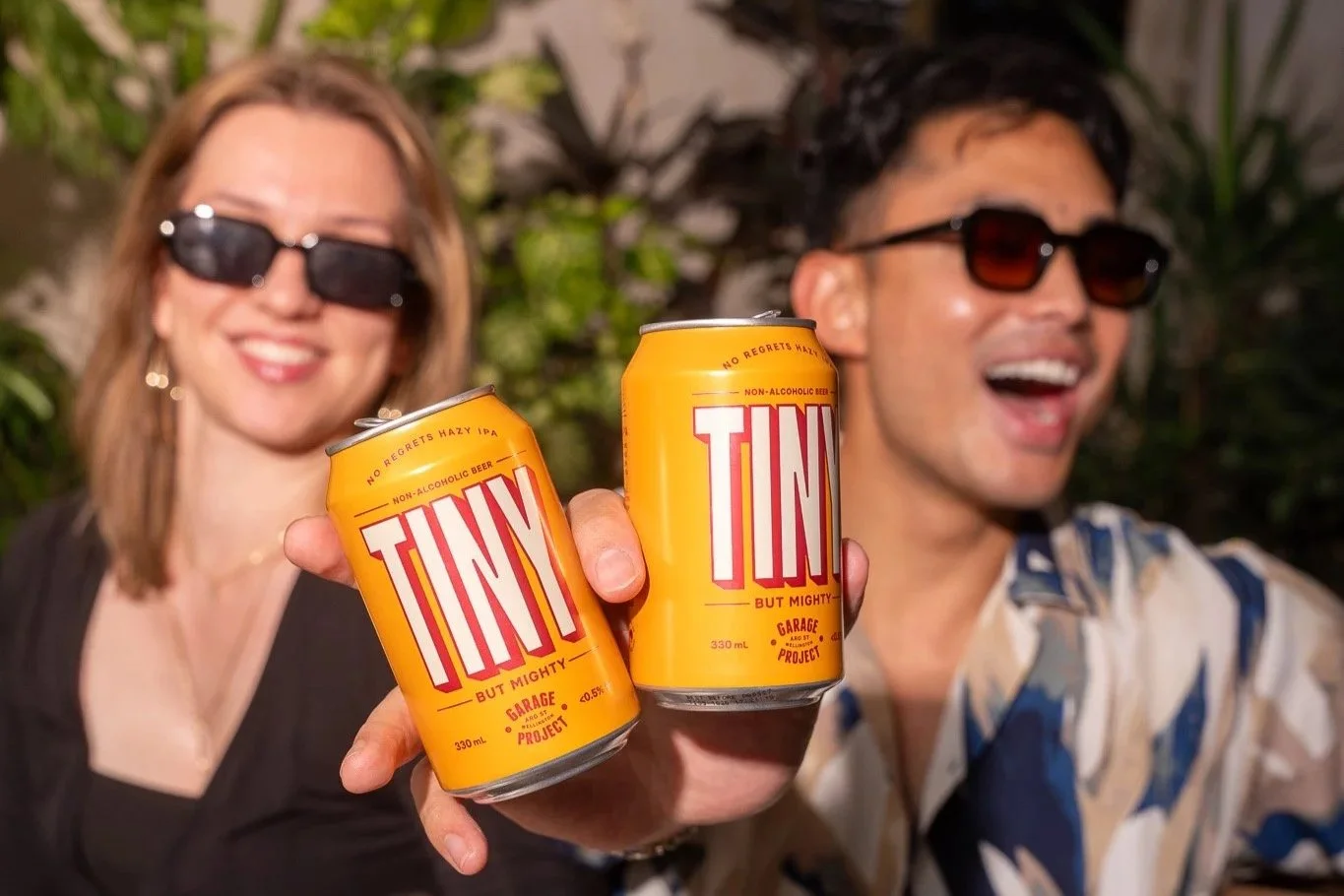
That is exactly where TINY fits. Brewed by Garage Project using arrested fermentation techniques that preserve the hop character, mouthfeel, and full flavour of a craft beer, TINY gives you something worth reaching for on the non-alcoholic round. Not a consolation drink. Not a placeholder. A beer you would choose on its own merits.
The Hazy IPA at 79 calories. The IPA, XPA, and Lager with Lime each at 59 calories. All under 0.5% ABV. All designed to hold their own next to whatever you are alternating with.
A Note on the Pressure to Name Everything
There is a part of me that finds the trend-naming industrial complex slightly exhausting. Zebra striping. Damp drinking. Sober curious. Book-ending. Every behaviour gets a label, every label gets a trend piece, every trend piece gets shared by the people who were already doing the thing before it had a name.
But I think the naming actually matters here, for a specific reason. For a long time, choosing not to drink at certain moments carried a social weight that was disproportionate to the actual decision. You were opting out. You were making a statement. You had to explain yourself.
Zebra striping does something useful: it makes the choice feel deliberate rather than defensive. You are not skipping a drink because you have had enough. You are following a pattern. You are making a considered choice about your evening. That reframing is not trivial. It changes how the choice reads, to yourself and to the people around you.
And in a social culture where what you drink still communicates something about who you are, that reframing is doing real work.
What Comes After the Name
The interesting question about zebra striping is not whether the trend is real. It clearly is. The interesting question is what it normalises.
Because once alternating between alcoholic and non-alcoholic drinks in the same evening becomes just a thing people do, the conversation shifts. The NA option stops being the backup. It becomes a genuine first choice for certain rounds, evaluated on its own terms. And that changes what you need the product to be.
Not a compromise. Not a watered-down version of the real thing. Something genuinely worth choosing when the stripe lands on non-alcoholic. That is the bar TINY is built to clear.
Bright and hoppy days ahead.