
The Growing Popularity of Non-Alcoholic Beer: A Shift in Consumer Attitudes
By Jimmy C.
There's a moment that tells you a lot about where a category actually stands culturally.
It's not the sales figures. It's not the number of SKUs on a shelf. It's whether someone picks up a non-alcoholic beer in front of their friends without a second thought — or whether they feel like they need to explain themselves.
For a long time, that moment was uncomfortable. Choosing an NA beer at a bar or a dinner carried a quiet social cost. You were opting out. You were being responsible. You were, the implication went, being slightly boring. The product wasn't just judged on flavour — it was judged on what it said about you.
That's the attitude shift worth talking about. Because it's changing faster than most people realise.
The Stigma Was Real — And It Was Earned
Let's not pretend the old reputation was unfair. NA beer used to taste bad, and people knew it. The product was made by stripping alcohol out of full-strength beer through heat or reverse osmosis — processes that fundamentally alter the aroma, body, and flavour of the beer. What arrived in your glass was technically beer, legally beer, but experientially something hollow and vaguely disappointing.
When a product consistently fails to deliver, the social stigma that grows around it isn't irrational. It's feedback. People tried NA beer, found it lacking, and formed an opinion. Choosing it at a social event started to feel like a public admission that you were either abstaining from alcohol or settling for something lesser.
The category carried that association for decades. And it was only going to shift when the product itself shifted.
What Changed: The Product First, Then the Culture
The brewing breakthrough — controlled fermentation that limits alcohol production from the start, rather than stripping it out afterwards — changed what was actually possible in the glass. Research has shown that beers made through arrested fermentation retain the volatile aromatic compounds that dealcoholisation destroys, preserving the hop character, body, and mouthfeel that make craft beer worth drinking.
When the product stopped being a compromise, the cultural conversation started to catch up.
Research from the University of Oxford in collaboration with Heineken found that consumers now view choosing a non-alcoholic beer as a confident decision — with participants describing non-alcoholic drinkers as 'respectable' (25%) and even 'cool' (9%) rather than 'boring' (6%) or 'uncool' (4%). The stigma is eroding. Not because of marketing campaigns, but because the product genuinely improved and people started choosing it on its own merits.
The social acceptability of not drinking in social settings is also normalising faster among younger generations, who feel more empowered to set their own boundaries around alcohol. Consumers are increasingly 'zebra striping' across the spectrum — full-strength beer, non-alcoholic beer, functional beverages — sometimes in the same evening, without it feeling like a statement either way.
The Numbers Behind the Shift
The attitude change is now showing up clearly in the market data.
Global no-alcohol beer volumes grew 9% in 2024 and IWSR projects the category will reach over 18 billion servings by 2029 — enough for every person on the planet to consume two each. That's not a niche trend. That's a category entering the mainstream.
In the US, non-alcoholic beverage sales hit $740 million in the latest 52-week period — a $175.8 million increase year-on-year, reflecting a 31% increase in the number of buyers and a 26% increase in spending per buyer. People aren't just trying it once out of curiosity. They're coming back.
Moderation spans demographics too: 75% of Gen Z consumers reported moderating their intake in the past six months, but so did 74% of Millennials and 66% of Gen X. This is a broad behavioural shift, not a generational anomaly.
The Occasion Is the Point
The more useful frame for understanding how NA beer fits into modern drinking culture isn't abstinence vs. drinking. It's occasion-led choice.
Someone might still order a full-strength IPA on a Friday night with friends. But make a different call at a mid-week networking event when they've got an 8:00 AM client presentation. Or choose something NA before a long training run. Or pace themselves through a four-hour work dinner because they need to actually remember the conversation.
In markets like Singapore, where professional calendars and social calendars run simultaneously at high intensity, that flexibility has a very practical value. But you see the same shift happening in London, Tokyo, Sydney — urban, high-performance environments where the cost of a slow morning is real.
Where TINY Fits Into This
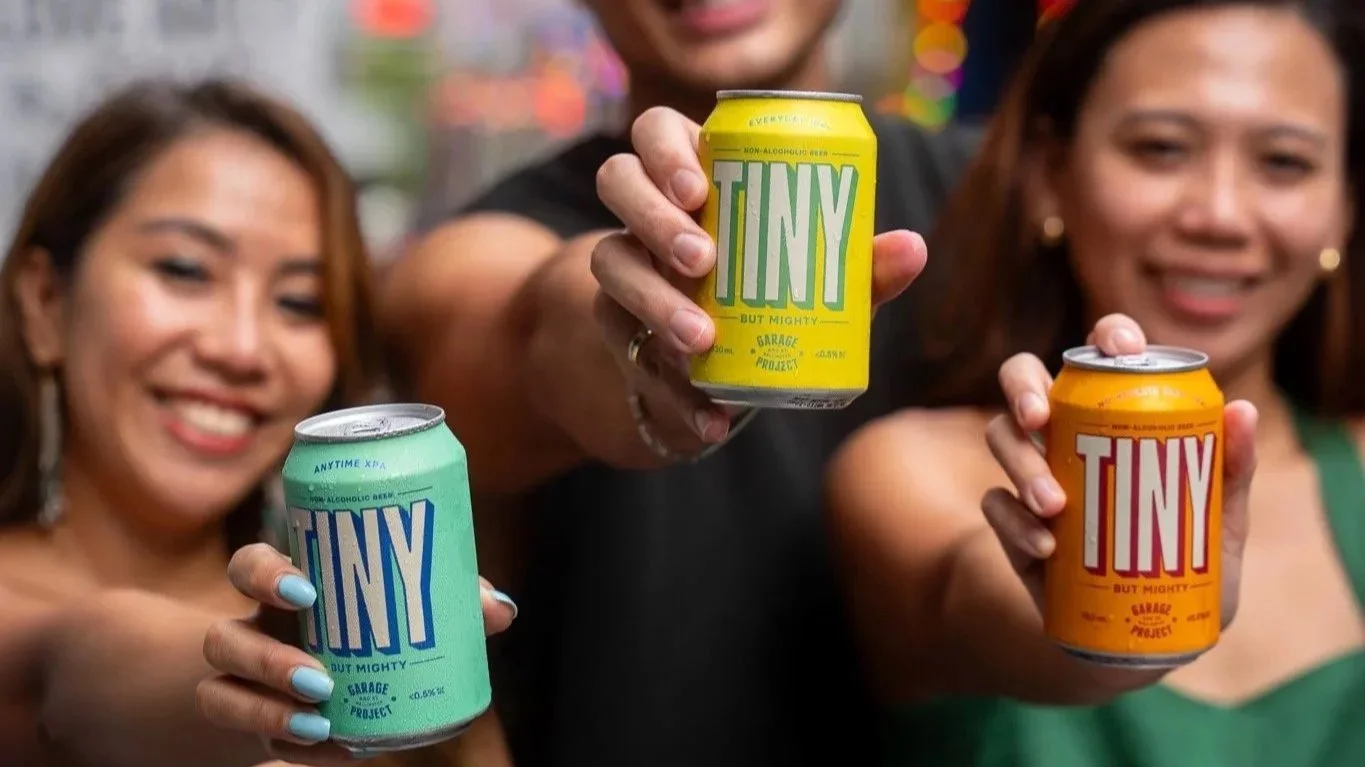
TINY was built for this shift — not as a wellness brand, not as an abstinence product, but as a genuine craft beer that happens to sit at under 0.5% ABV.
Brewed by Garage Project in Wellington using specialised fermentation rather than dealcoholisation, the range is designed to hold its own on flavour: the Hazy IPA with its tropical, full-bodied hop character (79 cal); the IPA with bright citrus and a proper bitter finish (59 cal); the XPA for a smoother, more sessionable option (59 cal); the Lager with Lime for the warm evenings that Singapore does so well (59 cal).
Beer that you'd reach for because it's worth drinking — not because you're trying to make a point about alcohol.
That's the attitude shift in a nutshell. NA beer used to be chosen reluctantly, as a last resort. Now it's being chosen first. By people who have plenty of options, and know exactly what they want.
Bright and hoppy days ahead.